
 Amazon has evolved from a retail platform into the world’s largest product search engine. Millions of shoppers now begin their buying journey directly on Amazon rather than Google, making Amazon SEO a critical discipline for authors, publishers, and brands. Understanding Amazon SEO Top Rankings can make a significant impact on your visibility and sales.
A modern Amazon SEO Top Ranking requires an integrated approach that aligns discoverability, conversion, and external authority signals. When executed properly, this framework not only improves rankings but also compounds visibility across marketing channels, including press release marketing and PR distribution initiatives.
Understanding How Amazon’s Algorithm Really Works
Amazon’s search engine prioritizes one core objective: revenue per search. Every ranking decision ultimately serves the likelihood that a shopper will purchase.
This means Amazon evaluates listings through two lenses simultaneously. The first is textual relevance—how well a product matches a search query. The second is behavioral performance—how shoppers interact with the listing once they find it.
The Three Pillars of Amazon SEO
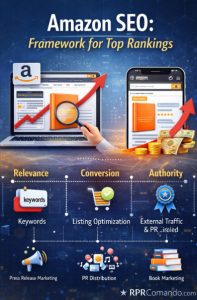
A reliable Amazon SEO Top Rankings framework rests on three interconnected pillars: relevance, conversion, and authority.
Relevance begins with keyword architecture. Titles, subtitles, backend search terms, and category placement tell Amazon what a product is about. But effective keyword strategy goes beyond stuffing popular phrases. It maps buyer intent across discovery stages, from broad interest searches to specific problem-solution queries.
Conversion is the second pillar. Amazon monitors click-through rate, add-to-cart behavior, purchase rate, and dwell time. Visuals, pricing, positioning, and copy must align with shopper expectations created by the search query. Misalignment reduces conversion and suppresses ranking.
Authority forms the third pillar. Reviews, ratings, brand recognition, and off-Amazon traffic signal trust and demand. Listings that attract external attention—media mentions, influencer coverage, or PR campaigns—often experience ranking lifts because Amazon detects increased purchase momentum.
Keyword Strategy That Mirrors Buyer Intent
Effective Amazon SEO begins with understanding how shoppers actually search. Unlike Google, Amazon queries are highly transactional. Users type phrases that reflect purchase goals rather than general curiosity.
Keyword research therefore requires mapping intent layers. High-volume head terms capture broad visibility, while long-tail phrases capture motivated buyers. For example, a book might target both “leadership” and “leadership communication skills for managers.”
Backend keywords expand reach without cluttering visible copy. Categories and subcategories act as structural keywords, placing products into Amazon’s topical graph. Proper category placement can dramatically affect ranking potential. Importantly, keywords should align with positioning.
Conversion Optimization: The Hidden Ranking Engine
Many sellers underestimate the role of conversion in Amazon rankings. Yet conversion metrics are often the decisive factor separating page-one products from invisible ones.
Titles must balance keyword inclusion with clarity and appeal. Images should communicate value instantly, especially for books and branded products where emotional resonance matters. Descriptions and A+ content should answer the shopper’s implicit question: why this item, right now.
Reviews amplify conversion credibility. Even small improvements in rating averages or review count can significantly affect ranking stability. Amazon interprets positive reviews as satisfaction signals tied to revenue probability.
Pricing strategy also influences conversion. Listings positioned competitively within their category often maintain stronger ranking momentum. Amazon’s algorithm favors products that maximize sales consistency rather than occasional spikes.
External Traffic and the Role of PR
One of the most powerful but underused Amazon SEO levers is external traffic. When shoppers arrive from outside Amazon and convert, the algorithm registers incremental demand. This often boosts ranking because Amazon perceives broader market interest.
This is where press release marketing and PR distribution become strategic SEO tools. Media coverage, blog features, and digital PR campaigns can drive targeted audiences directly to Amazon listings. The resulting sales velocity strengthens ranking signals.
For authors, Book Marketing campaigns that integrate PR with Amazon optimization can be especially effective. Media visibility creates credibility, which improves conversion, which improves ranking. The cycle reinforces itself.
Platforms like enable brands and authors to distribute press releases across high-authority outlets, amplifying awareness and traffic. This kind of PR-driven visibility not only builds brand perception but also feeds Amazon’s ranking algorithm through measurable sales impact.
Category Strategy and Competitive Positioning
Amazon rankings are contextual. Products compete within categories, not across the entire marketplace. Strategic category placement can therefore dramatically influence visibility.
Selecting subcategories with aligned demand but manageable competition improves ranking probability. Products placed in overly broad categories may struggle to gain traction despite strong relevance.
For books, niche category placement can create bestseller momentum, which then enhances authority signals across Amazon. Bestseller badges increase conversion rates and reinforce ranking loops.
Amazon SEO Top Rankings Sustaining Rankings Through Momentum
Launch phases require concentrated traffic and conversion activity to establish baseline ranking. PR distribution, influencer outreach, and promotional campaigns can accelerate this phase.
Post-launch, maintaining reviews, updating keywords, refreshing visuals, and sustaining traffic sources preserves ranking stability. Products that lose engagement gradually decline because Amazon favors consistent performers.
Long-term leaders in Amazon search results are not simply optimized; they are continuously marketed.
Integrating Amazon SEO With Marketing Strategy
The most successful Amazon SEO strategies integrate platform optimization with broader marketing activity. Search visibility, PR, content marketing, and brand building reinforce each other.
Press release marketing introduces products to new audiences. PR distribution creates authority and backlinks. External media coverage drives traffic. Traffic drives Amazon sales. Sales drive rankings. Rankings drive organic discovery with Amazon SEO Top Rankings.
For authors and brands alike, this integrated model transforms Amazon from a passive sales channel into an active marketing engine. Listings become conversion hubs supported by ongoing visibility campaigns.
The Framework for Top Amazon Rankings
A reliable Amazon SEO framework aligns relevance, conversion, and authority within a continuous marketing loop. Keywords ensure discoverability. Listing optimization ensures purchase behavior. PR and external traffic ensure demand signals.
In the modern marketplace, Amazon SEO is no longer separate from brand strategy. It is its most measurable expression.